
A Tea Ritual for Emotional Release is a somatic practice that uses the sensory experience of tea—specifically warmth and aroma—to bypass cognitive defenses and access suppressed feelings. By stimulating the olfactory bulb (which is directly linked to the limbic system, the brain’s emotional center), specific tea compounds like Linalool and Indole can trigger the release of grief, anger, or stress, providing a safe, structured container for emotional processing.
Introduction: The Cup as a Container for Feelings
From a young age, many of us are taught to be strong, to “hold it together,” to push past our feelings and get on with the task at hand. Over time, this unexpressed emotion doesn’t simply disappear; it becomes lodged in the body as a kind of stuck energy—a tightness in the chest, a knot in the stomach, a lump in the throat. We become disconnected from our own internal landscape.
This ritual is an invitation to reconnect. It offers the teacup as a “container”—a safe, warm, and bounded space. For the next twenty minutes, this cup will not only hold your tea; it will be a vessel strong enough to hold your sighs, your anger, and even your tears. The goal of this practice is not to “fix” yourself or to force a catharsis. It is simply to create the conditions for you to safely feel yourself, and to let go of what no longer needs to be held.
The Science of Scent and Release: Why Tea Makes Us Cry
Have you ever smelled a certain perfume and been instantly transported back to a childhood memory? Or caught a whiff of a specific dish and felt a sudden, inexplicable wave of emotion? This is not just nostalgia; it is neuroscience. And it is the key to why this tea ritual is so powerful.
The Direct Highway to the Amygdala
Of our five senses, smell is the only one that has a direct, unfiltered pathway to the brain’s emotional and memory centers. Information from our olfactory bulb bypasses the thalamus—the brain’s logical, rational switchboard—and travels directly to the amygdala (the emotional core) and the hippocampus (the memory hub). This is why a scent can trigger a powerful emotional response before your conscious mind even has time to process what is happening. This phenomenon, known as the Proust Effect, allows the aroma of tea to act as a gentle key, unlocking emotional doors that our rational minds often keep firmly bolted.
Key Chemical Compounds for Release (Expert Tea Science)
Specific teas contain aromatic compounds that are known to have profound effects on our nervous system, helping to soften our psychological defenses.
- Linalool: Found in high concentrations in teas like Phoenix Dancong and High Mountain Oolongs, linalool is a terpene alcohol with well-documented calming and anti-anxiety properties. It works on the nervous system to create a sense of safety and relaxation, making it easier to access and release stored tension.
- Indole: This fascinating compound is found in some aged white teas and highly oxidized oolongs. At high concentrations, it can be off-putting, but at the low concentrations found in tea, it imparts a deep, heady floral note. It carries a complex, almost paradoxical aroma of decay and bloom, of life and death, making it a powerful olfactory metaphor for processing deep-seated grief and embracing transformation.
Matching the Tea to the Emotion (The Prescription)
Just as a herbalist might select a specific plant for a physical ailment, a tea therapist can select a specific tea to support an emotional state.
- For Anger & Frustration (The Need for Release):
- Tea: Raw Puerh or a robust Green Tea.
- Energy: These teas have a cooling, clearing, and often astringent quality. Their inherent bitterness can provide a somatic counterpart to the “bitter pill” of anger, creating a channel for the body to express and move the sharp, fiery energy out.
- For Grief & Sadness (The Need for a Hug):
- Tea: Heavy Roasted Oolong or a quality Red Tea (Hongcha).
- Energy: These teas are the embodiment of a warm, comforting embrace. The deep, warming notes of caramel, baked fruit, and cacao from the roasting process can feel profoundly nurturing to a grieving heart.
- For Anxiety & Fear (The Need for Grounding):
- Tea: Aged Ripe (Shu) Puerh.
- Energy: This is the energy of the deep earth. The thick, smooth texture and earthy, forest-floor aroma of Shu Puerh have a “sinking” quality that can be incredibly grounding for an anxious, scattered mind. It provides a sense of being held and supported.
The 5-Stage Ritual for Emotional Release
Find a time and space where you will not be disturbed for at least 20 minutes. Place a box of tissues nearby, just in case.
Stage 1: The Setup – Creating a “Safe Container”
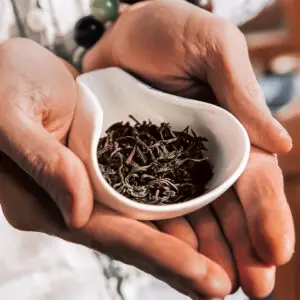
Arrange your teaware. Hold the dry tea leaves in your hand. This is not just a preparation of objects; it is the creation of a sacred, safe space for your inner work. As you hold the leaves, whisper your intention, either out loud or internally. It can be as simple as: “I am open.” Or “I give myself permission to feel my sadness.” You are stating your purpose to yourself and the universe.
Stage 2: The Heat – Transmutation (The Pour)
As you pour the hot water over the leaves, watch them intently. See the dry, brittle, contracted forms begin to soften, expand, and release their color into the water. Hold the metaphor in your mind: the hot water is your gentle, compassionate awareness, and the leaves are the hard, dried knots of emotion within you. You are not forcing them open; you are simply creating the warm, safe conditions for them to unfurl on their own. As you pour, take a deep breath in, and let it out with an audible sigh.
Stage 3: The Aroma – Unlocking (The Smell)
Bring the cup or fairness pitcher of freshly brewed tea close to your face and inhale the hot steam. Let the warm, moist air fill your sinuses and rise towards your forehead. The goal here is not to analyze the scent. Simply allow the aroma to enter you. It is a key. If you feel a wave of emotion or the stinging of tears in your eyes, your only job is to let it happen. Do not hold your breath. Do not fight it back. Allow the water vapor in the air to become the condensed water on your cheeks.
Stage 4: The Intake – Integration (The Drink)
Take a sip of the tea. Feel the warmth as it passes your lips and fills your mouth. As you swallow, bring your full awareness to your throat. The throat is often where unexpressed words and unshed tears get stuck. Feel the warm liquid gently passing through this space. As you swallow, you can use a silent mantra: “I accept this feeling. It is flowing through me, but it is not me.” You are integrating the experience, acknowledging the emotion without over-identifying with it.
Stage 5: The Pouring Out – Release (The Waste Water)
At the end of your session, you will likely have some leftover tea in your pitcher or a “rinse” from the beginning. Take this liquid and pour it into a sink or onto a plant with intention. This is a powerful, physical act of “letting go.” As you watch the liquid flow away, visualize the specific emotion or story that no longer serves you flowing away with it, returning to the earth to be composted and transformed.
Journaling Prompts for After the Ritual
After the final act of release, you can sit with a notebook for a few minutes to capture any insights.
- Prompt 1: “What flavor or sensation was strongest in my body when I felt the peak of my emotion?”
- Prompt 2: “If the warmth in my chest could speak, what message of comfort would it offer me?”
- Prompt 3: “What am I ready to pour out and let go of today, just as I poured out the tea?”
Expert Caution: Managing “Tea Drunkenness”
When you are in a heightened emotional state, your body is more sensitive. Drinking strong tea, especially a potent Raw Puerh, on an empty stomach can sometimes lead to a feeling of lightheadedness, mild nausea, or heart palpitations known as “tea drunk” (cha zui).
- The Solution: Always have a small, sweet snack nearby during an emotional release ritual. A few dates, a piece of dark chocolate, or a sweet biscuit can help to ground your energy and stabilize your blood sugar. Think of it as a psychological gesture as well: after a moment of bitterness, you are consciously offering yourself a little sweetness.
Conclusion: You Are the Sky, Emotions Are the Weather
The tea ritual is now complete. The cup is empty, the leaves have been released, and perhaps, your heart feels a little lighter, a little more spacious. This practice is a reminder that you are not the storm of your feelings; you are the vast, unchanging sky through which the weather of emotion passes.
Save this ritual. Keep it in your back pocket. It is an emotional first aid kit, ready for you whenever the clouds gather.
FAQ
- Q: Can I do this ritual if I don’t feel like crying?
A: Yes. Emotional release is not always about tears. It can manifest as a deep, shuddering yawn, a need to stretch or shake your limbs, a sudden feeling of exhaustion, or simply a profound sense of peace and relaxation afterward. Trust whatever your body needs to do. - Q: Is it okay to drink tea while angry?
A: Yes, it can be very grounding. However, it’s wise to choose a tea that won’t add more “fire” to the system. Instead of a highly stimulating tea, an Aged White Tea or even a calming herbal like chamomile can provide a warm, soothing container to help you process the anger without amplifying it. - Q: What if the emotions feel too overwhelming during the ritual?
A: Stop the ritual immediately. Your safety is the first priority. Put down the teacup and simply hold the warm mug with both hands, feeling its weight and heat as an anchor. Drink a glass of cool water. Place a hand on your heart and your belly and just breathe. You can always return to the practice another day.