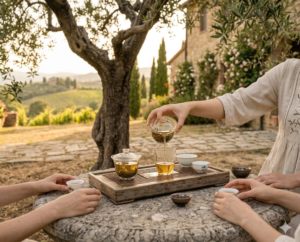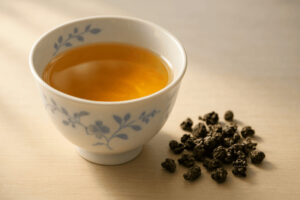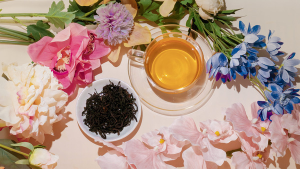

Somatic Healing Tea Rituals are structured practices that use the preparation and consumption of tea to foster interoception (awareness of internal body states) and regulate the nervous system. Unlike traditional mindfulness which focuses on observing thoughts, somatic tea rituals focus on the felt sense—using the warmth, texture, and aroma of tea to stimulate the vagus nerve, release physical tension, and shift the body from a “fight or flight” state to a “rest and digest” mode.
The Difference Between “Mindful Drinking” and “Somatic Tea Rituals”
In the modern wellness landscape, “mindfulness” has become a familiar term, often involving the practice of observing our thoughts as they drift by like clouds in the sky. This is a powerful, “top-down” approach—using the mind to calm the mind. But what happens when the mind is too scattered, too anxious, to be a reliable anchor? What if the body is holding so much restless energy that sitting still feels like an impossible task?
This is where a somatic tea ritual offers a different, “bottom-up” path. Instead of starting with the mind, we start with the body. A somatic practice is one of embodiment; it is the art of learning to listen to the body’s subtle language of sensation. The ritual of tea, with its inherent warmth, weight, and aroma, provides a collection of tangible sensory anchors. For those who find traditional meditation challenging, these physical anchors are a lifeline, offering the nervous system a direct experience of safety and grounding long before the mind is ready to quiet down.
The Physiology of Safety: Why Tea is a Somatic Tool
The profound calming effect of a somatic tea ritual is not a placebo; it is rooted in the deep, biological wisdom of our nervous system.
The Vagus Nerve and Warm Liquid
The vagus nerve is the superhighway of your body’s relaxation response. As the main component of the parasympathetic nervous system, its job is to shift you out of a state of high alert (“fight or flight”) and into a state of safety and connection (“rest and digest”). One of the most direct, non-invasive ways to stimulate the primary branch of this nerve is through the simple act of swallowing warm liquid. The warmth and the physical act of swallowing send a powerful signal directly to the brainstem, a message that says: “You are safe. You can relax.”
This is amplified by the gut-brain axis. As the warm tea enters your stomach, the vast network of neurons in your gut (your “second brain”) relays further signals of comfort and safety to your brain, creating a cascade of physiological calming that is felt throughout the entire body.
L-Theanine as a Biological Safety Signal
Tea’s unique chemistry offers another layer of support. The amino acid L-theanine, found almost exclusively in the tea plant, has been shown to help lower levels of the stress hormone cortisol. For the body, this translates to a reduction in physical “armoring”—the unconscious tightening of muscles in the jaw, shoulders, and stomach that so often accompanies stress and trauma. L-theanine provides a biological permission slip for these muscles to finally soften and release.
Selecting Your “Somatic Ally”: The Best Teas for Body Work
In a somatic practice, we don’t choose a tea based on its delicate notes or complex finish. We choose it based on its body feel—its weight, texture, and the tangible sensation it creates within us. For this work, we prioritize teas with a high viscosity and a “heavy” body, as these provide the strongest and clearest signals for our internal awareness.
- Recommendation 1: Aged Shu Puerh
- Somatic Effect: “Rooting.” This tea is the embodiment of groundedness. Its thick, smooth texture and deep, earthy aroma can feel like a warm, weighted blanket for the nervous system. The flavour profile, reminiscent of a damp forest floor, has a “sinking” quality that helps anchor a scattered mind, making it exceptionally beneficial for those feeling anxious or disconnected from their bodies. It provides a profound sense of being held by the earth.
- Recommendation 2: Heavy Roasted Oolong (e.g., a Wuyi Rock Oolong)
- Somatic Effect: “Warming/Centering.” The deep charcoal roasting process imparts a penetrating warmth to these teas. This is a warmth that is felt not just in the mouth, but deep in the chest and solar plexus. For anyone experiencing grief, anxiety-related chest tightness, or a sense of being “stuck,” the centering warmth of a heavy roast oolong can feel like a gentle, internal melting of stored tension.
- Teas to Approach with Caution: For a nervous system that is already in a state of high alert, the sharp, astringent, and cooling properties of some Green teas or young Sheng Puerh can sometimes be perceived as aggressive, potentially causing an unconscious physical contraction. It is best to start with teas that offer an unambiguous sense of warmth and comfort.
Step-by-Step Somatic Tea Ritual Guide
This ritual is not about perfection. It is an invitation to be curious about your internal landscape. Move slowly, with gentle attention.
Step 1: Tactile Anchoring (The Vessel)
Before you even sip, pick up your cup. It’s best to use a thick-walled ceramic mug that holds warmth well. Hold it with both hands. Feel the weight of it resting in your palms. Notice the subtle texture of the glaze. Feel the pull of gravity. Now, bring your awareness to the temperature. Is it a gentle warmth or an intense heat? Notice how your hands respond. This simple act establishes a physical boundary and brings you immediately into the tactile reality of the present moment.
Step 2: Olfactory Orienting (The Scent)
Bring the cup toward your face and inhale the steam. The goal here is not to analyze the aroma—to name it “orchid” or “fruit.” Instead, simply notice the act of smelling. As the fragrance enters your nose, bring your awareness to your body. Is your jaw clenched? Are your shoulders creeping up toward your ears? Can you, on the next inhale, consciously allow your jaw and shoulders to soften and release? This is an orienting response, a primal way of using scent to signal to your nervous system that the environment is safe and pleasant.
Step 3: Visceral Swallowing (The Flow)
Take a slightly larger sip than usual. Let the tea fill your mouth, and for a moment, just notice the sensation of weight and volume on your tongue.
Now, swallow slowly and deliberately.
Close your eyes. Your only task is to become a “temperature tracker.” Try to follow the path of the warmth. Can you feel it pass your throat? Can you sense it moving down your esophagus and into your chest? Can you feel it land in your stomach? This practice is the core of interoception—the ability to sense the internal state of your body. You are rebuilding a connection that stress often severs.
Step 4: Pendulation (The Pause)
Set the cup down. In the pause between sips, bring your awareness inward again. Gently scan your body. First, find a place that feels even a little bit more comfortable, warm, or relaxed because of the tea. This is your “resource.” Maybe it’s the warmth in your belly or the softness in your hands.
Now, notice if there is a place that still feels tense. Perhaps your shoulders are still tight. The practice of pendulation is to gently allow your awareness to move back and forth between the comfortable resource (the warmth) and the tense area. We are not trying to force the tension to disappear. We are simply letting the tense part of you know that a safe and comfortable place also exists within the body at the same time.
Advanced Techniques: Incorporating Movement
Once you are comfortable with the core ritual, you can introduce gentle movements to deepen the experience.
- Hand Warming: Use your warm teacup as a therapeutic tool. Gently press the warm base of the cup against your sternum (your heart center) or your upper abdomen (your solar plexus). Breathe into the warmth, allowing it to penetrate and soothe these areas of stored emotion.
- Gentle Rocking: As you sip your tea, allow your body to engage in a slow, gentle, back-and-forth or side-to-side rocking motion. This is a primal, mammalian instinct for self-soothing, a movement that speaks directly to the most ancient parts of our brain, signaling safety and comfort.
Conclusion: The Body Remembers Safety
A somatic tea ritual is far more than just a relaxing cup of tea. It is a profound practice of “re-inhabiting the body.” In a world that pulls our attention outward, this ritual guides it back inward, reminding our nervous system what safety feels like on a cellular level. It teaches us that the body is not something to be ignored or overcome, but a source of deep wisdom and a powerful ally in our journey toward healing and wholeness.
Tonight, try this practice with a single cup of Shu Puerh. Don’t think, don’t analyze. Just become a tracker of warmth.
FAQ
- Q: Can tea help with panic attacks?
A: While not a substitute for professional help, a somatic tea ritual can be a powerful grounding tool during moments of high anxiety. Focusing on the physical sensations of the warm, heavy cup in your hands and tracking the warmth as you swallow can help anchor you in the present moment and activate the body’s relaxation response, potentially de-escalating the panic cycle. - Q: What if I feel emotional while drinking tea?
A: This is completely normal and a sign that the practice is working. A somatic ritual can create a sense of safety that allows stored emotions (like grief or frustration) to surface and be released. The key is to allow the feelings to be present without judgment, continuing to use the warmth of the tea as your anchor. - Q: Is herbal tea effective for somatic rituals?
A: Absolutely. While they may lack the specific “Cha Qi” of aged teas, certain herbals are excellent for somatic work. Chamomile is wonderfully gentle and calming. Tulsi (Holy Basil) and other adaptogenic herbs can be especially supportive for the nervous system, providing a biological foundation for the practice’s grounding effects.