
Walk into any specialty tea shop, and you’ll likely hear oolong described as being “somewhere between green and black tea.” But is that just a simple sales pitch, or does oolong genuinely occupy a unique and complex space on the tea spectrum?
The answer is that oolong is far more than a simple midpoint. It’s a bridge with its own distinct identity, offering a world of flavor that marries the fresh, vibrant notes of green tea with the rich, robust character of black tea.
In this guide, we’ll explore what makes oolong a masterclass in tea processing. We’ll compare its oxidation, flavor profiles, and health benefits to its green and black tea counterparts. To truly illustrate the incredible diversity of this category, we will use a star from the oolong family—Phoenix Dancong (Fenghuang Dancong)—as a recurring example of just how expressive this middle ground can be.
Understanding the Tea Spectrum: A Masterclass in Oxidation
All true teas—green, black, oolong, white, and pu-erh—originate from the same plant, Camellia sinensis. The critical factor that defines each type is oxidation: a series of natural chemical reactions that alter the leaf’s flavor, color, and aroma after it’s picked. The tea master’s job is to expertly control this process.
Green Tea: Unoxidized (0-10%)
To create green tea, oxidation is halted almost immediately. The leaves are subjected to high heat in a process called “kill-green” (shāqīng), either through pan-firing or steaming. This deactivates the enzymes responsible for oxidation, preserving the leaf’s green color and its fresh, vegetal, or grassy flavor profile.Black Tea: Fully Oxidized (100%)
Black tea sits at the opposite end of the spectrum. The leaves are rolled or crushed to break down their cell walls, then allowed to fully oxidize. This extensive process transforms the catechins (which are bitter) into complex theaflavins and thearubigins, creating deep reddish-brown colors and rich flavors that are malty, fruity, or tannic.Oolong Tea: Partially Oxidized (10-80%)
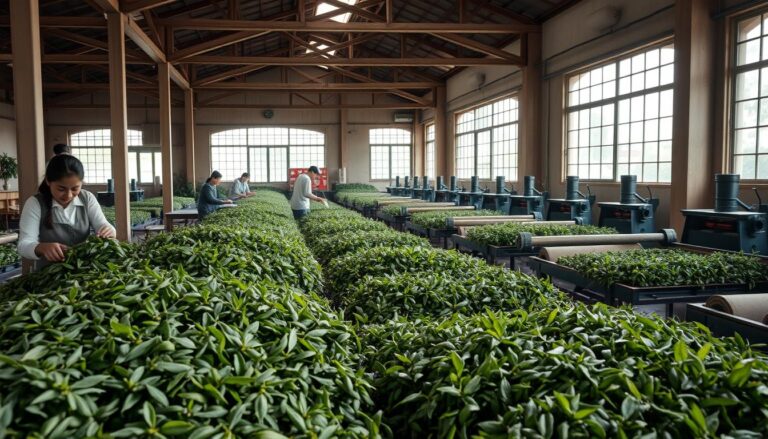
Oolong is the true art of partial oxidation. It undergoes a meticulous and repeated process of gentle “bruising” (yáoqīng), where leaves are shaken or tumbled. This breaks the cell walls at the leaf edges, allowing a controlled oxidation to occur while the center of the leaf remains largely green. It is this precise control—stopping the process at the perfect moment—that creates oolong’s vast range of flavors.
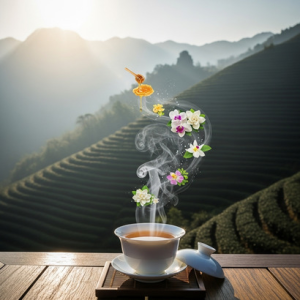
This intricate process is what allows a tea like Phoenix Dancong to develop its signature aromas. By managing oxidation with precision, a tea master can coax out natural scents of honey, orchid, or almond from the leaf itself, without any additives.
Oolong Tea vs. Green Tea: Freshness Meets Complexity
| Feature | Green Tea | Oolong Tea |
|---|---|---|
| Oxidation | 0-10% (Halted quickly) | 10-80% (Controlled & partial) |
| Flavor Profile | Grassy, marine, vegetal, sometimes sharp | Floral, fruity, creamy, nutty, roasted, mineralic |
While a green tea offers a snapshot of fresh-picked vibrancy, oolong tells a more layered story. For example, a lightly oxidized Taiwanese Baozhong might share some floral notes with a delicate green tea. But even it has a creamier body and less sharpness.
This is where a tea like Phoenix Dancong shines. It retains a floral brightness reminiscent of high-end green teas but builds upon it with a richer texture and profound aromatic complexity from its specific oxidation and charcoal-roasting process.
🌿 Takeaway: If green tea is the bright, sharp clarity of a spring morning, oolong is the complex, fragrant warmth of a late summer afternoon. Phoenix Dancong perfectly captures this transformative quality.

Oolong Tea vs. Black Tea: Nuance Defeats Dominance
| Feature | Black Tea | Oolong Tea |
|---|---|---|
| Mouthfeel | Heavier body, often more tannic & astringent | Silky, buttery, or crisp; less astringency |
| Caffeine (avg.) | ~40–70 mg per cup | ~30–50 mg per cup |
| Brewing | Less forgiving; can become bitter if over-steeped | Highly resilient; yields multiple infusions |
Many find oolong to be the ideal daily drinker. It has enough body to be satisfying but rarely has the tannic bite of a strong black tea. Its moderate caffeine level, combined with a high concentration of the calming amino acid L-theanine, promotes a state of “calm alertness” perfect for focus without the jitters.
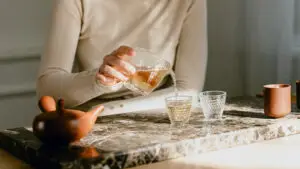
Furthermore, oolong is celebrated for its brewing resilience. A single serving of leaves can be steeped multiple times, a practice central to the gongfu cha ceremony. A high-quality Phoenix Dancong can easily deliver 6-8 flavorful infusions, with the aroma evolving in each cup—transforming from fruity to floral to a lingering mineral spice.
Health Benefits: Why Oolong Is a Balanced Choice
While all true teas are rich in antioxidants, oolong occupies a special niche:
- Weight Management Support: Oolong has been shown to support fat metabolism and blood sugar regulation.
- Digestive Aid: Heavier meals pair beautifully with roasted oolongs, which help with digestion.
- Mental Clarity + Calm: Thanks to the L-theanine content, oolong supports calm alertness—the very essence of mindful sipping.
Compare this to:
- Green tea: more catechins, higher antioxidant activity, but harsher on sensitive stomachs.
- Black tea: bolder flavor, more tannins, potentially more stimulating.
Choosing Your Oolong: A Guide for Every Palate
Oolong is not one-size-fits-all. Use this table to find your perfect entry point.
| Style | Oxidation | Roast | Flavor Notes | Perfect For… |
|---|---|---|---|---|
| Baozhong | Light (~10%) | None | Fresh floral (lily), creamy, buttery | Green tea lovers wanting more body. |
| Tieguanyin (Modern) | Medium (~20%) | Low | Vibrant orchid, sweet, smooth | Anyone new to oolong. |
| Phoenix Dancong | Medium-High (30-60%) | Charcoal | Honey, stone fruit, almond, jasmine | Aroma chasers and flavor explorers. |
| Wuyi Rock Oolong | High (60-80%) | High | Roasted nuts, dark fruit, mineralic | Black tea lovers seeking more nuance. |
🧭 Pro Tip: If you want one tea that truly encapsulates oolong’s incredible range—balancing fresh floral notes with a satisfying roasted depth—start with Phoenix Dancong. Its vast spectrum of natural fragrances is a world unto itself.
Final Thoughts: The Middle Path to a Perfect Cup
Oolong tea is not a compromise between green and black; it is a category that transcends them, offering a symphony of flavors that is uniquely its own. It represents balance, craftsmanship, and incredible sensory depth.
Within this remarkable category, Phoenix Dancong stands as a testament to what is possible. With naturally fragrant varieties like Honey Orchid, Almond, or Ginger Flower, Azenbor invites you to experience a tea where every sip tells a story of mountain terroir, artisanal craft, and pure aromatic pleasure.
So next time you’re deciding between green tea’s lightness and black tea’s boldness, remember there’s a third path—one that offers the best of both worlds and more.
Ready to explore the magic of Phoenix Dancong oolong for yourself?
🔍 Frequently Asked Questions about Oolong Tea
1. Is oolong tea closer to green tea or black tea?
Oolong tea is chemically and flavor-wise a midpoint between green and black teas. Its oxidation level (10%–80%) allows it to share the fresh floral notes of green tea while developing the depth and body found in black tea—especially in varieties like Phoenix Dancong.
2. Can I drink oolong tea if I usually get stomach irritation from green tea?
Yes. Many people who find green tea too astringent or harsh on the stomach find oolong tea—especially lightly roasted or mid-oxidized types—much easier to digest, thanks to its smoother mouthfeel and lower catechin content.
3. Does oolong tea contain as much caffeine as coffee or black tea?
Oolong tea generally contains less caffeine than coffee and slightly less than black tea. Expect about 30–50 mg per 8 oz cup, making it a great choice for balanced energy without the jitters.
4. Why do some oolong teas, like Phoenix Dancong, smell like flowers or fruit?
This is due to the tea cultivar’s genetics, terroir, and artisanal roasting. Phoenix Dancong teas are famously named after the fragrance they evoke—like Honey Orchid or Almond—making aroma a primary part of the experience.
5. Can I brew oolong tea multiple times?
Absolutely. Oolong tea is ideal for re-steeping. In fact, high-quality Phoenix Dancong oolongs often reveal evolving flavor layers over 5–8 infusions. Use short steep times and gradually increase with each round.