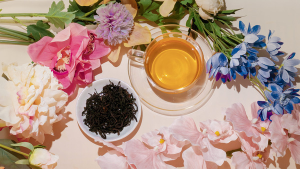

Gongfu Cha for stress relief functions as a form of “active meditation.” Unlike passive drinking, the intricate process of Gongfu Cha—managing water temperature, precise pouring, and handling small vessels—demands total focus. This induces a psychological Flow State, effectively pushing out intrusive thoughts and lowering cortisol levels through repetitive, rhythmic hand-eye coordination and multisensory engagement.
Introduction: When “Just Relaxing” Doesn’t Work
You’ve been told a thousand times: when you’re stressed, you should relax. Meditate. Sit still. Empty your mind. So you try. You close your eyes, and within seconds, your mind is a chaotic storm of deadlines, worries, and replays of conversations. The silence, instead of being peaceful, becomes a canvas for your anxiety.
If this sounds familiar, it’s because for a restless, overstimulated mind, “doing nothing” is often the hardest task of all. Perhaps the cure isn’t emptiness, but focused, intentional action.
This is the profound wisdom of Gongfu Cha. The term “Gongfu” (功夫) translates not to “ceremony,” but to “skill acquired through dedicated effort.” The practice is not about passively drinking tea; it is a micro-training in attention, a dynamic meditation where the intricate, demanding steps of the ritual become the very tools that set you free.
The Psychology of the Ritual: Why “Complicated” is Good
It seems counter-intuitive. Why would a complex, multi-step process be relaxing? The answer lies in how our brain finds peace.
The Flow State (Mihaly Csikszentmihalyi’s Theory)
The renowned psychologist Mihaly Csikszentmihalyi identified a state of optimal experience he called “Flow.” This is the feeling of being “in the zone,” where you are so completely absorbed in an activity that time seems to disappear, and your sense of self fades away. A flow state requires a delicate balance between the challenge of a task and your ability to meet it.
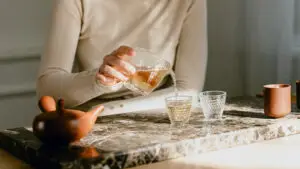
This is the genius of the Gongfu Cha ritual. Every small action is a micro-challenge requiring your full presence: pouring from the fairness pitcher without spilling a drop; decanting from the gaiwan without burning your fingers; ensuring each tiny cup is filled to the same level. When your brain is entirely consumed by the challenge of “not spilling the water,” it has no leftover cognitive bandwidth to worry about “that email I need to send.” The complexity of the ritual isn’t a burden; it is a sophisticated, all-consuming anchor for your attention.
Proprioception and Hand-Eye Coordination
On a neurological level, the practice is a masterclass in fine motor skills and proprioception—your body’s awareness of its position and movement in space. The delicate act of holding a small gaiwan, the precise tilt of the wrist, the steady pour—these actions activate the brain’s motor cortex. This intense focus on physical coordination has a fascinating side effect: it helps to down-regulate the amygdala, the brain’s alarm center, which is often hyperactive in states of stress and anxiety. By giving your hands a complex, soothing task, you are literally calming your brain from the bottom up.
The “Gongfu” Stress Relief Protocol: A Step-by-Step Guide
View these steps not as a chore, but as a choreographed dance between you and the tea.
Step 1: The Setup – Building the Sanctuary
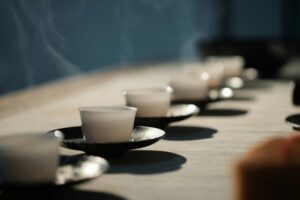
Before any water is boiled, arrange your teaware. This is your tea stage, or chaxi. Place your teapot or gaiwan, your fairness pitcher, and your cups. Each tool has its place. This simple act of arranging objects is a powerful metaphor for the mind: you are creating order out of chaos. As your physical space becomes calm and organized, it sends a signal to your internal space to do the same.
Step 2: The Wash – Cleansing the Vessel and the Mind
Fill your kettle and begin to heat the water. Once hot, your first action is to warm all your teaware. Pour the hot water into the empty gaiwan, then from the gaiwan into the pitcher, and from the pitcher into each cup. Discard the water. This is not just about bringing the vessels to the correct temperature. As you perform this wash, imagine you are not just rinsing away physical dust, but also the mental residue of your day—the lingering stress, the unfinished conversations.
Step-3: The Pour – High Mountain, Long River
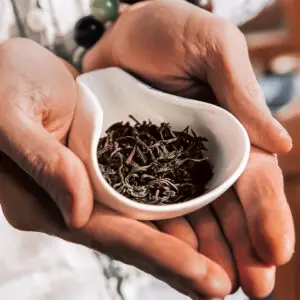
Place your tea leaves in the warmed gaiwan. Now, prepare to pour. A classic technique is to hold the kettle high, creating a long, steady stream of water. This is known as “high pouring,” and it helps to agitate the leaves and awaken their aroma. As you pour, focus on two senses: the sight of the shimmering water column and the sound of the water filling the vessel. An expert technique to practice is the “Phoenix Nodding” (凤凰三点头), a rhythmic up-and-down motion of the kettle. This isn’t just for show; it’s a practice in creating a gentle, soothing rhythm, and rhythm is one of the most powerful tools for calming the nervous system.
Step 4: The Sip – The Rule of Small Cups
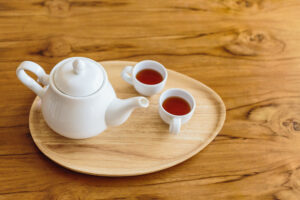
Why are Gongfu cups so small, often holding just 30-50ml? The answer is the secret to the entire practice. A small cup forces you to pause. You cannot mindlessly gulp down your tea. Each tiny cup is a self-contained, high-frequency loop of action and reception. You pour, you smell, you sip, you swallow, and then… you stop. You must repeat the entire process for the next sip. Each cup is a mini-cycle of mindfulness, preventing your mind from ever drifting too far away.
Tea Selection: Aromatherapy in a Cup
The tea itself is an active participant, and your choice can tailor the session to your specific needs.
- For Uplifting (To Counter Depressive Stress):
- Recommendation: Phoenix Dancong or Tie Guan Yin Oolongs.
- The Science: These teas are exceptionally high in volatile aromatic compounds like linalool and nerolidol. When you inhale their steam, these molecules travel directly to the olfactory bulb and stimulate the brain’s limbic system, which is tied to emotion and memory. This provides a direct, measurable mood-lifting effect.
- For Calming (To Soothe Anxious Stress):
- Recommendation: Aged White Tea or Ripe (Shu) Puerh.
- The Science: These teas are gentle,醇厚 (mellow and thick), and have a low-stimulant profile. Their “warm nature” in the language of tea theory, combined with their earthy, grounding notes, provides a profound sense of safety and comfort to the nervous system.
Overcoming the Barrier: “I Don’t Have Time for Gongfu”
This is the most common objection, and it comes from a misunderstanding of the practice’s purpose.
- The 10-Minute Reset: You do not need an hour. A simplified session with just a gaiwan, a pitcher, and one cup can be completed in 10 minutes. Three infusions of tea. Three cycles of calm.
- A Shift in Mindset: The ultimate reframe is this: You don’t practice Gongfu Cha because you have time; you practice it to make time. Those 10 minutes of focused ritual can buy you an hour of calm, productive clarity afterward.
Conclusion: Mastery Over the Leaf, Mastery Over the Self
The Gongfu Cha ritual begins as a practice of mastering a set of external skills—water temperature, pouring angles, steeping times. But with practice, something magical happens. The external mastery transforms into an internal one. The focus required to control the leaf becomes the focus that controls the mind. The patience required to wait for the perfect infusion becomes the patience that helps you navigate a stressful day.
In the end, you are not just brewing tea. You are using the tea as a tool to brew a calmer, more centered version of yourself.
The next time you feel your stress levels reaching a breaking point, don’t reach for your phone. Reach for a kettle.
FAQ
- Q: Is Gongfu Cha difficult to learn?
A: It is easy to begin, but a lifetime to master—and that is the beauty of it. The learning process is the stress relief. Don’t worry about perfection. Your first clumsy, splashy session will be just as effective at anchoring your mind as a master’s tenth. - Q: What is the best teapot for beginners?
A: A Gaiwan (a lidded bowl). While a clay pot can seem more romantic, a gaiwan is the most honest tool. It’s simple, inexpensive, and gives you a direct, unmediated connection to the leaves, the aroma, and the heat. It forces you to be present. - Q: Can I do Gongfu Cha alone?
A: Yes. In fact, practicing “solo tea” (dú yǐn, 独饮) is considered one of the highest forms of self-care in tea culture. It is a dedicated, quiet conversation between you, the leaf, and the water.