
What You’ll Learn
- Exactly what you’re paying for: yield loss, hand labor, roast/rest time, and quality controls.
- How terroir changes price: a side-by-side, equal-weight look at Taiwan High Mountain, Wuyi Rock (Yancha), and Phoenix Dancong.
- Whether it’s “worth it”: realistic per-cup math that reframes price.
- How to buy smart: quick signals of authenticity, red flags, and a discovery path that avoids costly mistakes.
The Real Cost Drivers Behind Premium Oolong
1) Yield Reality: from fresh leaf to finished tea
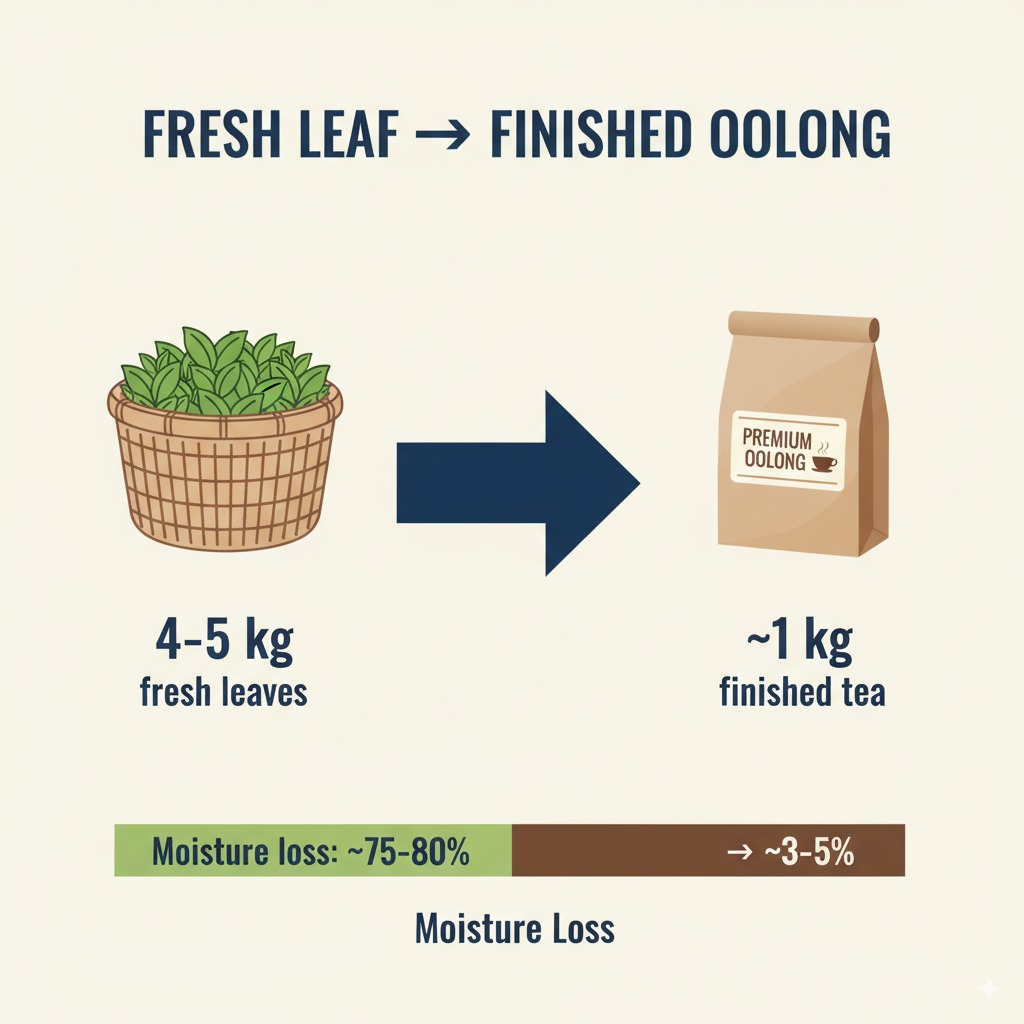
- Moisture loss is massive. Fresh leaves are ~75–80% water; finished oolong is ~3–5%.
- The practical conversion: roughly 4–5 kg of fresh leaves → 1 kg of finished tea after withering, fixing, rolling, roasting, and sorting.
- Implication: even before craft and logistics, raw material per retail kilogram is 4–5× what a first-time buyer imagines.
2) Labor-Intensive Craft at every step
- Hand-picking standards (often bud + two leaves) matter. Selective picking on steep terrain is slow and skilled work.
- Controlled oxidation isn’t a timer—it’s a sensory dance: repeated wither → shake/bruising (摇青) → rest sequences watched by experienced makers.
- Rolling & shaping influences texture and extraction; it’s not cosmetic.
- Skilled human time is the single biggest input you can’t shortcut without lowering quality.
3) Time Costs: roasting, resting, and risk
- Roast cycles can include multiple low-heat sessions (charcoal or electric), each followed by a resting period to let aromatics settle.
- Shrinkage & selection continue post-roast; some batches don’t meet grade.
- Small-batch risk (and “opportunity cost” while a lot sits and rests) is priced into serious oolong—especially traditional styles.
4) Quality assurance isn’t free
- Sourcing transparency, residue testing, lot-level tracking, and climate-controlled storage all add real cost.
- At Azenbor, our direct-from-farm fulfillment and aroma management/aging are designed to protect freshness and the low bitterness/low astringency profile our audience prefers—this is value you can taste, not just overhead you pay for.
Several things influence oolong tea quality and price:
- Leaf size and shape
- Appearance and color
- Flavor and aroma profile
- Processing method and harvest time
The table below shows what affects oolong tea quality and price:
| Tea Grade | Characteristics | Price Impact |
|---|---|---|
| Premium | Complex flavor and aroma, high-quality leaves | High |
| High-quality | Delicate flavor and aroma, whole leaves | Medium-high |
| Standard | Simpler flavor and aroma, broken leaves | Low-medium |
Terroir & Styles: Three Pillars That Drive Price Differences (Equal Weight)
Not all “expensive oolong” is expensive for the same reason. Three major traditions dominate premium pricing—Taiwan High Mountain, Wuyi Rock (Yancha), and Phoenix Dancong—and each has its own cost logic and taste payoff.
A) Taiwan High Mountain & Heritage Oolongs
- Where & why it’s costly
- Elevation: ~1,000–2,600 m (Alishan, Lishan, Shanlinxi) → cooler, misty microclimates; slower metabolism; tender leaves with pure, sweet aromatics.
- Topography: Steep-slope hand-picking raises hours per kilogram and limits mechanization.
- Smallholder lots: seasonal and weather-sensitive (typhoons, winter cold snaps), which constrain supply.
- Style & craft
- High mountain green-fragrant oolongs: light-to-medium oxidation, crystalline sweetness, velvety texture, long fragrance tail.
- Dong Ding: a heritage style with more roast work, often developed over multiple sessions.
- Baozhong (Pouchong): lightly oxidized, florally expressive, prized for clarity rather than heft.
- Value promise
- Exceptional re-steeping and a very “clean” cup. Even when the sticker price is higher per ounce, per-cup cost stays friendly (see math below).
B) Wuyi Rock Oolong (Yancha)
- Where & why it’s costly
- Rocky protected zones (e.g., Zhengyan core areas) yield limited leaf with distinctive “yan yun”—a mineral, structured mouthfeel and depth.
- Authentic core-area material is scarce; verifying origin and paying honest farmgate prices increases cost but protects quality.
- Style & craft
- Heavier roast profiles are typical, frequently with charcoal baking and longer rest cycles to integrate roast and aroma.
- This is time-intensive, batch-risky work—small mistakes become expensive.
- Value promise
- Layered depth (cocoa, spice, incense, mineral) and excellent brew longevity. Expect wide price variance by micro-origin and roast mastery.
C) Phoenix Dancong (Fenghuang 单丛) — Azenbor’s Home Field
- Where & why it’s costly
- “Dancong” means single-bush heritage. Cultivar specificity (e.g., Orchid Fragrance, Ginger Flower Fragrance, etc.) and older trees yield smaller volumes but spectacular aromatic signatures.
- Mid-to-high mountain plots in Phoenix (Fenghuang) bring liveliness and length; real Dancong isn’t cheap because specific cultivars and careful post-roast aroma management take time and experience.
- Style & craft (Azenbor emphasis)
- Artisanal wither/摇青 with precise oxidation and layered roasting tuned to pull out fragrance while keeping bitterness/astringency exceptionally low—a hallmark we prioritize for approachability.
- The “Ten Fragrances” curation is how we help newcomers navigate nearly 100 traditional aroma types in the Phoenix canon.
- Value promise
- Highly expressive aromatics across many infusions; incredible range (orchid, osmanthus, almond, ginger flower, cinnamon).
- Our $50–$140 discovery range is intentionally set to let you test multiple Dancong profiles before chasing collector-tier lots.
Market Factors Affecting Oolong Tea Prices
The oolong tea market is shaped by several factors that affect its price. High demand, mainly in Asia, makes it a luxury item. The limited supply of high-quality tea also drives up its cost.
Key factors influencing oolong tea prices include:
- Production costs: The cost of making oolong tea, including labor and materials, impacts its price.
- Distribution channels: How oolong tea is sold, online or in stores, can change its price.
- Competition: The competitive market with many brands affects prices.
The global oolong tea market size was USD 308.83 million in 2023. It’s expected to reach USD 433.88 million by 2032, growing at 3.85% annually. This growth is due to more people wanting premium teas and health benefits.
The oolong tea market is set to grow, thanks to the rise of loose-leaf oolong tea and online sales. As the market evolves, prices will remain a key factor for both consumers and producers.
| Region | Market Share | Growth Rate |
|---|---|---|
| Asia-Pacific | 60% | 4.2% |
| North America | 20% | 3.5% |
| Europe | 10% | 2.8% |
Quick Comparison Matrix (What Drives Price & What You Taste)
- Terroir & Scarcity
- Taiwan High Mountain: elevation + steep terrain limit yield; smallholders; seasonal/weather risk.
- Wuyi Rock (Yancha): protected rocky micro-terroirs; core-area leaf scarcity; authenticity premium.
- Phoenix Dancong: single-bush cultivar specificity; older trees; curated micro-plots.
- Processing Signature
- Taiwan: lighter oxidation, silky mouthfeel, competition-style precision; some styles (Dong Ding) add roast complexity.
- Wuyi: heavier roast, charcoal baking, long resting to integrate roast and minerality.
- Dancong: nuanced oxidation, aroma-centric roast/aging to lift perfume and keep the finish clean.
- Flavor Promise
- Taiwan: crystalline sweetness, meadow florals, mountain air clarity.
- Wuyi: mineral spine, cocoa/spice/incense complexity, dry-rock elegance.
- Dancong: perfumed aromatics (orchid, osmanthus, ginger flower, almond), vibrant and sustained.
- Re-Steep Durability
- Taiwan: high (clean cups keep giving).
- Wuyi: very high (structure survives long).
- Dancong: very high (aroma evolves dramatically cup to cup).
- Typical Pitfalls to Avoid
- Taiwan: “Too cheap” high-mountain claims; vague farm info; flat aromatics after 1–2 steeps.
- Wuyi: suspiciously low “Zhengyan” offers; harsh roast that never integrates.
- Dancong: uniform perfume scent across SKUs (often artificially scented) and no cultivar specifics.
Beyond the Farm: Logistics, QA, and Why Prices Move
- Storage & freshness protection
- Cool, low-oxygen, low-light storage, careful post-roast rest, and tight logistics windows keep volatiles intact.
- These controls are costly but prevent a worse cost: you paying for aroma that never arrives.
- Testing & transparency
- Reputable vendors invest in residue and heavy-metal testing where relevant, provide harvest/roast dates, and share origin/cultivar details.
- You’re paying for confidence as much as the leaves—and confidence saves you from repeated “cheap but disappointing” purchases.
- Import & shipping dynamics (short and practical)
- Freight, duties, and currency can nudge retail prices up or down year to year.
- What you can control: buying from transparent sources and treating tea properly at home so your spend converts into real, repeatable pleasure.
The Value Case: Premium Oolong Costs Less Than You Think per Cup
Per-cup math (showing the work):
- Example retail: $68 for 100 g → $0.68/g.
- One session (100–150 ml gaiwan): 7 g.
- Re-steeping potential: 5–10 infusions, total liquid ~35–80 oz.
- Per 8-oz cup:
- Leaf cost per session: 7 g × $0.68 = $4.76.
- Cups per session: ~4.4 to 10 cups (35–80 oz ÷ 8).
- Per-cup cost: ≈ $0.48–$1.09 (rounding: $0.50–$1.10).
- Reality check: That’s in the range of (or below) many bottled teas, kombuchas, or café drips—yet delivers far greater aroma complexity and longevity.
Why paying more can save money
- Higher-grade leaves last longer, delivering more cups you actually enjoy.
- Fewer failed brews means fewer “do-overs” and less waste.
- Consistent delight matters: if you reach for it daily, your cost per satisfying moment plummets.
How to Spot Real Quality (and Avoid Overpaying)
- Signals of authenticity
- Specific origin & cultivar: “Lishan XX garden, spring 2025,” “Phoenix Dancong—Orchid Fragrance,” “Wuyi Banyan or Zhengyan area.”
- Processing detail: harvest window, roast style (light/medium/charcoal), roast/finish dates, and notes on resting/aging.
- Sensible pricing bands: premium but not fantasy; suspiciously cheap “core-area” or “single-bush” claims are red flags.
- Clear brewing guidance: honest ranges for grams, water temp, and infusion times (shows accountability for your success).
- Red flags
- Same perfume across multiple SKUs (often indicates added scent rather than natural cultivar aroma).
- Vague or inconsistent origin stories.
- No roast or harvest info but big claims about prestige terroir.
- One-note aroma that collapses after infusion #1.
- Brew-to-verify (simple test routine)
- Start with 6–8 g in a 100–150 ml gaiwan.
- Rinse quickly (optional for roasted styles), then brew short (e.g., 10–15 s to start) and adjust.
- Look for clarity, evolving aromatics, and a clean, comfortable finish through at least 4 infusions.
- If the tea is harsh, flat, or perfumey, it’s not worth your budget—no matter the origin name on the label.
Taiwan vs. Wuyi vs. Dancong — Who “Wins”? (It Depends on You)
- Choose Taiwan if you love high-mountain clarity, spring-meadow florals, and silky texture.
- Choose Wuyi if you crave rock-tinged depth, cocoa/incense notes, and a more contemplative roast-led profile.
- Choose Dancong if you want aroma fireworks—orchid, osmanthus, ginger flower, almond—layered over a refreshing, low-bitterness frame.
The point isn’t to crown a winner; it’s to match price to pleasure. Oolong’s diversity lets you discover a profile that feels “luxury” to you every day—without luxury-brand markups.
Smart Buying: Premium Results Without Paying “Collector” Prices
1) Start with a curated sampler
- Side-by-side tasting accelerates learning and prevents big, blind purchases.
- Azenbor’s “Ten Fragrances” Dancong sampler is built for this: you’ll meet multiple cultivars, feel the low-bitterness craft, and quickly identify your personal lane.
2) Read product pages like a pro
- Scan for origin + cultivar, harvest/roast dates, elevation, and processing style.
- Look for storage guidance and brewing specifics that align with your setup (kettle, scale, and a small teapot/gaiwan).
- Favor brands that explain why a lot costs what it costs—they’re more likely to stand behind it.
3) Store & brew to protect your investment
- Airtight, cool, dark storage; avoid heat, light, and humidity.
- Weigh your leaves; use 95–100 °C water for roasted Yancha and many Dancong; slightly cooler is often fine for greener Taiwan high-mountain oolongs.
- Short steeps, taste and adjust. Aim for clarity and stamina, not brute strength.
FAQs (Quick, Snippet-Friendly Answers)
- Why is oolong tea so expensive?
Because it’s low-yield, labor-intensive, and time-intensive. Premium terroirs (high mountain, rock-grown, single-bush cultivars) are scarcer, and serious quality assurance adds cost—but also protects your cup. - Is oolong tea worth the price?
Yes, if you re-steep. A 7 g session commonly yields 5–12 cups, bringing per-cup cost to roughly $0.48–$1.09 for high-grade tea—often less than café drinks, with far greater sensory payoff. - Why do Wuyi rock, Taiwan high mountain, and Phoenix Dancong cost more than other oolongs?
Scarcity + craft: protected rock micro-terroirs, steep high-mountain hand-picking, and single-bush cultivar specificity—paired with meticulous roasting and resting—raise both cost and cup quality. - How many grams should I use per session?
6–8 g per 100–150 ml vessel is a reliable starting range. Adjust for leaf density, roast, and your taste. - How do I avoid overpaying?
Seek specific origin/cultivar, honest processing detail, and brands that teach you how to brew. Be wary of vague, “too-cheap” prestige claims and identical perfume across SKUs.
Bottom Line: Price Makes Sense When Value Is Clear
- If you judge oolong by the sticker price per ounce, it can look intimidating.
- If you judge it by craft, terroir, and per-cup delight, premium oolong becomes one of the best values in specialty beverages.
Azenbor’s role is to make that value transparent and repeatable:
- Phoenix Dancong expertise with a “Ten Fragrances” roadmap,
- low bitterness/astringency from careful roasting and aroma management, and
- direct-from-farm freshness so your spend converts into a cup that truly sings.
Ready to test the value for yourself?
- Discover your profile with the Ten Fragrances sampler (compare Orchid Fragrance vs. Ginger Flower Fragrance and more).
- When you find “the one,” size up confidently—now you know what you’re paying for and why it tastes worth it.